
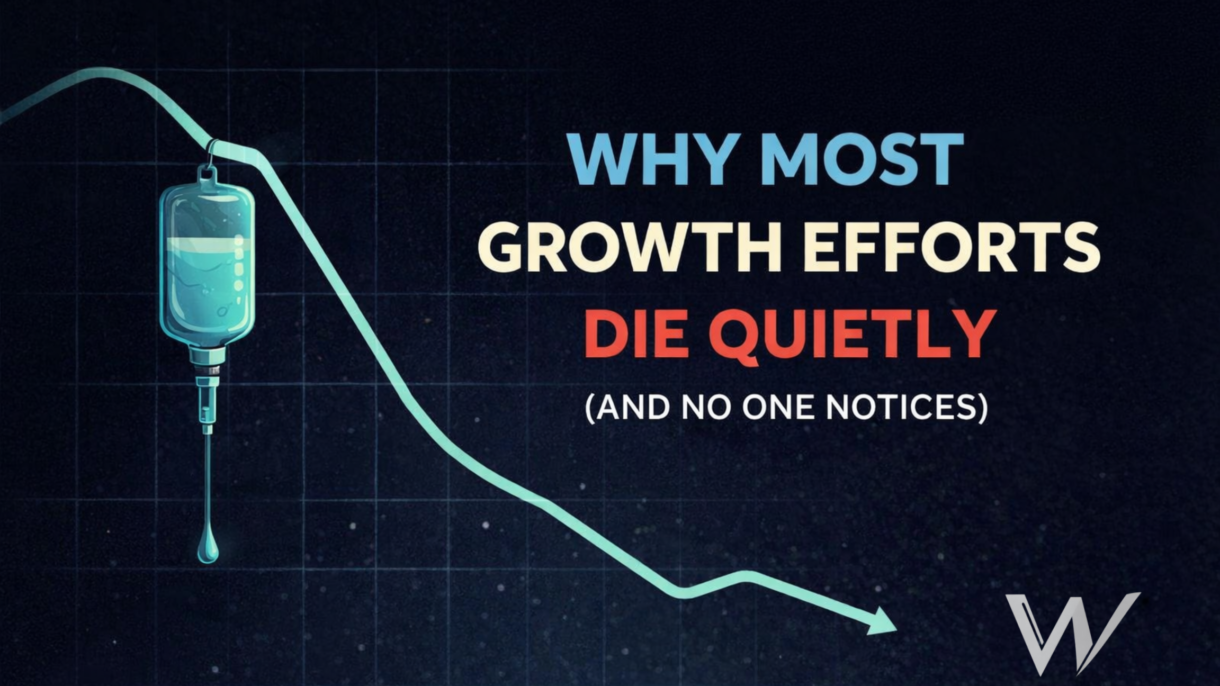

Let’s get this out of the way first: Most growth does not fail loudly
There’s no dramatic crash.
No Slack message that says “We’ve officially messed this up”
No post-mortem meeting with dramatic slides.
Growth usually dies politely.
- It fades.
- It slows.
- It stabilizes.
- It becomes a thing people stop talking about and start explaining.
And the worst part?
Everyone involved is usually working hard.
Table of Contents
The Silent Death of Things That Were Supposed to Work
I’ve watched this happen more times than I can count.
- A new website launches.
- A funnel goes live.
- Content starts going out consistently.
- Ads get tested.
- A CRM gets set up.
There’s excitement at first then nothing dramatic happens.
Just less momentum than expected.
So the story changes:
- Maybe the market shifted
- People are more distracted now
- It takes time
- We just need more volume
Translation:
No one actually knows what’s broken so nothing meaningful gets fixed.
Growth does not collapse but It slowly turns into background noise.
Why Quiet Failure Is More Dangerous Than Obvious Failure
When something fails loudly, it demands attention.
Servers go down → engineers swarm.
Revenue drops suddenly → panic, then decisions.
A launch bombs → lessons get documented.
Quiet failure does the opposite.
It creates false comfort:
- The dashboards still show activity.
- Traffic still exists.
- Leads still come in (just not enough).
- Meetings still happen.
So everyone assumes things are mostly fine and this is how companies stay stuck for years.
The Real Reason Growth Dies (It’s Not What You Think)
Here’s the uncomfortable truth:
Most growth efforts don’t fail because of tactics but they fail because they were never designed as systems.
They’re collections of actions, not structures and actions don’t compound.
Campaigns Feel Like Progress, Systems Create It
Campaign thinking sounds like this:
- Let’s try a new funnel
- Let’s post more
- Let’s tweak the homepage
- Let’s run ads for a month and see
System thinking sounds boring by comparison:
- What decision is this page meant to move?
- Where does trust actually get built?
- What breaks when traffic doubles?
- What happens after the click, not before it?
One creates activity, the other creates direction.
Guess which one survives pressure.
The Growth Illusion Everyone Falls For
Here’s a pattern I see constantly:
- Something works a little
- The team doubles down on the visible part
- The invisible weaknesses get ignored
- Growth plateaus
- Everyone blames the channel
The channel is almost never the problem, the structure behind it is.
A funnel without trust doesn’t scale.
Content without positioning doesn’t convert.
Traffic without structure just creates noise faster.
(Yes, that line stings, it’s supposed to)
Quiet Death Happens When Responsibility Is Fragmented
Another reason growth dies unnoticed?
No one actually owns the system.
- Marketing owns traffic.
- Design owns visuals.
- Sales owns closing.
- Operations owns delivery.
Everyone owns a piece but no one owns the through-line. So when results flatten, every team can point somewhere else.
This is how you end up with:
- A beautiful website that doesn’t sell
- Great content that attracts the wrong people
- Leads that feel low quality
- Teams working harder with worse results
Just misalignment hiding in plain sight.
The Most Expensive Phrase in Business: It’s Probably Fine
It’s probably fine is how quiet death continues.
- The homepage is probably fine
- The funnel is probably fine
- The offer is probably fine
- People just need more time
Time does not fix structure, time exposes it. If growth slows under normal conditions, it will break under pressure.
What Actually Keeps Growth Alive
Growth survives when it’s designed to hold weight. That means:
- Decisions are intentional, not reactive
- Every page has a job (not a vibe)
- Trust is engineered, not hoped for
- Systems are reviewed before they’re scaled
This is the unsexy work which people skip because it does not feel urgent until it is.
A Quick Reality Check (No Forms, I Promise)
If any of these feel familiar, you’re not alone:
- Your site looks good but feels awkward to explain
- Traffic exists, but confidence in it doesn’t
- You’re adding tactics instead of removing friction
- Growth feels fragile instead of predictable
If you nodded at even one of these, your growth is not dead, it’s unsupported.
(There’s a difference and it matters)
Why Most Teams Don’t Catch This Early
Because metrics don’t show structure problems clearly. They show outcomes, not causes. By the time numbers look bad, the system has already been decaying for a while.
Quietly.
That’s why the fix usually feels harder than expected. You’re not repairing a broken campaign but you’re rebuilding how decisions flow.
This Is Where Most Advice Falls Apart
Most growth advice assumes:
- You already have clarity
- You already have alignment
- You already have trust
- You just need better execution
That’s rarely true. Execution without structure just makes mistakes faster and faster mistakes still hurt.
The Shift That Changes Everything
Here’s the shift that actually works:
Stop asking How do we grow faster?
Start asking What breaks if this works?”
That question changes how you build. It forces you to think in systems instead of sprints and yes, it feels slower at first. That’s the point.
If this article felt uncomfortably accurate, good. That usually means you’re closer to fixing things than you think.
I work with founders and operators who are done guessing and ready to design growth that does not collapse the moment it gets attention.
If that sounds like you, don’t book a call. Just start a conversation. No pitch, no funnel tricks, just context.
(You’ll find the place to do that. I didn’t hide it)
Growth that dies quietly is not a failure of effort, it’s a failure of design and design problems don’t announce themselves but they wait.
If you have any questions or you want to get in touch, feel free to connect with me on LinkedIn.