Wajeeh
I build Growth Systems that compound
I build scalable
growth systems that
last
I work on scalable digital systems, premium offers, and long term brand leverage for founders who care about durability over noise.
I build Growth Systems that compound
I work on scalable digital systems, premium offers, and long term brand leverage for founders who care about durability over noise.
SYSTEMS I BUILD & SCALE
Growth Systems
Scalable acquisition and conversion systems designed to compound over time across content, funnels, and distribution.
Content & Authority
Long term content systems that build trust, positioning, and demand without chasing trends or short term attention.
Digital Infrastructure
Websites, funnels, and internal systems built for scale and durability not just aesthetics.

Wajeeh Ul Hassan
I’ve spent the last several years working across growth, content, and digital systems helping businesses build scalable acquisition, positioning, and conversion infrastructure designed to hold up over time.
My work spans multiple industries and markets, with hands-on involvement in content systems, funnels, websites, and internal workflows used by teams across the US, UK, Canada, and other global markets.
I’m less interested in tactics and short term wins, and more focused on building systems that compound structurally, strategically, and operationally.
Most of my work happens quietly, behind the scenes where systems are built, refined, and made durable.
Engagement Paths
Advisory & Strategy
Strategic guidance on growth systems, positioning, and infrastructure for founders and teams building long term assets.
Systems Build & Execution
Design and implementation of content systems, funnels, and digital infrastructure designed to scale and compound.
Education & Products
Frameworks, writing, and digital products designed to transfer systems thinking without ongoing dependency.
Writing & Thinking
Long form thinking on growth, systems, and leverage published selectively


Why Founders Burn Out Before Their Businesses Fail
Burn out is not weakness, it’s usually bad design wearing a human face. Let’s Kill the Wrong Story First. Founders love the wrong explanation for burnout.
They say things like:
- I just need better work life balance
- I need to manage stress better
- I need to be more disciplined
- I should delegate more
All of that sounds mature, most of it is wrong. Burnout is caused by carrying things that should never live in your head. The reason founders burn out before their businesses fail is simple and brutal:
The business keeps working because the founder is absorbing structural damage personally
The system leaks pressure and the founder becomes the pressure valve.
From the outside, it looks like leadership.
From the inside, it feels like suffocation.
Table of Contents
Why the Business Survives While the Founder Does Not
This part messes with people. How can the company be fine if I’m not? Easy.
- The business does not feel anxiety
- The business does not replay conversations at 3:06 a.m
- The business does not hold unresolved decisions in its chest
You do. Founders often think burnout means they’re failing. In reality, burnout often means they’ve been succeeding at the wrong thing:
Holding together systems that should hold themselves. The company looks stable because the instability has been internalized and that’s slow self erasure.
The Hidden Deal Founders Make
Early on, founders make an invisible trade:
I’ll carry this for now
This decision happens everywhere:
- I’ll just handle this client myself
- I’ll make the final call so the team doesn’t get stuck
- I’ll keep this in my head for now
- I’ll step in if something goes wrong
At the beginning, this is survival. Later, it becomes habit. Eventually, it becomes identity.
The founder becomes:
- the fallback
- the interpreter
- the emotional regulator
- the decision landfill
And because the business keeps moving, the founder assumes this is leadership. It’s deferred collapse relocated into a human nervous system.
Burnout Is Architectural
This is where most conversations go off the rails. People frame burnout as:
- emotional exhaustion
- mental health
- motivation loss
Those are symptoms not causes. The cause is architectural.
Burnout happens when:
- too many decisions terminate in one person
- too much ambiguity lives at the top
- too many unresolved trade offs remain open
- too many things depend on founder judgment
Your brain is not designed to be a load bearing structure. Yet most founder led businesses treat it like one.
That’s why vacations don’t fix burnout, mindfulness does not fix burnout and taking a break feels like putting a bandage on a cracked beam.
The Myth of the Strong Founder
Let’s talk about the most damaging lie in startup culture:
Strong founders can handle it
Strong founders do handle it and that’s the problem.
They absorb ambiguity instead of forcing resolution, absorb stress instead of redesigning flow and absorb responsibility instead of redistributing ownership. The business rewards them for this.
- Things don’t break
- Clients stay happy
- The team feels supported
So the founder keeps going until one day they realize:
- they can’t think clearly anymore
- every decision feels heavy
- even small issues feel exhausting
- the business needs them too much
That’s structural overload.
Why Delegation Advice Usually Fails
Every burnout conversation eventually lands on delegation.
Just delegate more
That advice assumes the problem is volume. Founders burn out because they’re holding too many unresolved decisions.
You can delegate tasks all day and still burn out if:
- you remain the final authority on everything
- people bring problems, not decisions
- ambiguity flows upward by default
In that setup, delegation just turns you into a review bottleneck. The workload moves but the pressure does not.
The Emotional Cost of Being the Adult in the Room
Founders rarely talk about this part honestly. Being the founder means you’re often the emotional sink.
You regulate:
- team anxiety
- client expectations
- investor uncertainty
- internal conflict
You translate chaos into calm. Over time, that regulation becomes one directional. Everyone feels lighter after talking to you but you feel heavier after talking to everyone.
It’s imbalance and imbalance sustained long enough turns into burnout because the system never learned to care for itself.
The Founder as the System’s Memory
Here’s a quiet but devastating pattern. In many founder led businesses:
- the founder remembers why decisions were made
- the founder remembers edge cases
- the founder remembers historical trade offs
- the founder remembers what breaks if we change this
The system does not remember, the founder does. That means every new decision requires the founder’s involvement not for authority but for context. Context doesn’t scale when it lives in a person.
This is one of the fastest paths to burnout because it creates a constant sense of obligation:
If I’m not involved, something important might be missed
That’s being trapped inside your own success.
Why Burnout Shows Up After Success
This confuses a lot of people. Why now? Why when things are finally working?
Because early stage chaos is obvious. Late stage chaos is subtle.
In the beginning:
- everything is broken
- expectations are low
- adrenaline is high
Later:
- expectations rise
- consequences increase
- decisions carry more weight
The founder’s role quietly shifts from builder to stabilizer without the system evolving to support that shift. Burnout appears not when things go wrong but when the cost of being wrong becomes too high to carry alone.
If this is hitting close to home, don’t rush to solve it yet. Just notice this question:
What am I currently carrying that the system should be carrying instead?
That question asks for awareness and awareness is where real redesign starts.
Why Founders Blame Themselves
Founders are dangerous like this, they internalize failure automatically.
- I should be better at this
- I should handle pressure better
- I should be more organized
This self blame feels responsible. It’s also convenient because it avoids redesign. If the problem is you, the system gets to stay the same. Burnout thrives in environments where self criticism replaces structural critique. The founder collapses inward instead of redesigning outward.
The Business Does Not Need You to Be Stronger
Your business does not need you to:
- be tougher
- be calmer
- be more resilient
It needs fewer things to depend on you. Strength is not the solution to fragility. The most durable founder led businesses don’t run on heroic founders but they run on boring systems that don’t require constant emotional labour.
At this point, the pattern should be clear. Founders burn out because:
- pressure flows upward
- ambiguity accumulates
- decisions terminate at the top
- systems externalize cost into a human
Now we’re going deeper.
Why Being Needed Is the Most Dangerous Signal of All
Founders love to feel needed. It feels like relevance, importance and proof that you matter. It’s also one of the most reliable predictors of burnout.
When people say, we can’t do this without you, it sounds flattering. What it actually means is that the system never learned to operate independently. Need is not loyalty or respect. Need is often structural failure wearing a compliment.
The more a business needs its founder for normal operation, the more pressure that founder carries silently. Not during crises but during routine and routine pressure is the kind that drains you without dramatic warning signs.
The Slow Shift from Builder to Buffer
Early on, founders build. Later, many founders buffer. They buffer:
- conflict between teams
- misaligned incentives
- unclear priorities
- weak ownership
- unfinished decisions
They become the layer that smooths everything out. The business appreciates this and the founder deteriorates.
Why? Because buffering is emotionally expensive and structurally invisible. No one thanks the foundation of a building, they only notice it when it cracks. Founders who act as buffers end up feeling unseen because the work they do leaves no artifact, it just prevents collapse. Preventing collapse feels like standing still while holding weight.
Why Burnout Often Comes with Guilt
Here’s something founders rarely admit. Burnout feels shameful.
- I shouldn’t feel this way
- Others have it worse
- I chose this
So founders push through. They suppress the signal, intellectualize it and keep showing up.
Guilt delays action long enough for burnout to deepen and because founders are usually competent, disciplined people, they assume guilt means they’re being dramatic not that the system is misdesigned. That misinterpretation costs years.
The Founder as the Decision Sink
Most founder burnout traces back to one pattern:
Too many decisions end with, Let’s just ask the founder
Because the founder has context, the founder sees the whole picture, the founder is trusted. Every decision that terminates at the founder adds a tiny weight. One or two don’t matter but hundreds do.
Over time, the founder becomes a decision sink absorbing unresolved trade offs that the system never learned to process and unresolved decisions stack. You feel burned out because your mind is full of open loops.
Why Founder Instinct Becomes a Trap
Founder instinct is powerful early. It’s fast, intuitive and cuts through noise. At scale, it becomes a bottleneck. When systems rely on founder instinct:
- decisions stop being explainable
- others hesitate to act
- learning does not propagate
Everything waits for the founder’s signal, the founder becomes the oracle and oracles are lonely. Worse, the business stops developing judgment muscles of its own. This is how founders end up exhausted while surrounded by capable people who still need approval.
The Emotional Weight of Permanent Optionality
Founders live in permanent optionality.
- They always could step in
- They always might need to
- They’re never fully off duty
This is more draining than constant work. Why? Because the nervous system never relaxes when responsibility is undefined. You don’t need to be working to be stressed, you just need to feel on call.
Many founders take vacations but never leave mentally. The system does not allow absence, only distance. Distance without detachment just changes the scenery.
Why Self Care Advice Misses the Point
Founders hear this a lot:
- Take care of yourself
- Set boundaries
- Rest more
None of that fixes structural overload. You can meditate all you want if decisions still funnel upward, the pressure remains. Self care treats burnout as a personal maintenance issue. Burnout in founders is usually a design flaw. You don’t fix a collapsing bridge by asking the pillars to relax.
The Moment Burnout Turns Dangerous
There’s a stage founders rarely recognize in time. It’s when:
- curiosity disappears
- patience shrinks
- resentment creeps in
- decisions feel heavy instead of interesting
It’s disengagement and disengaged founders make bad decisions because their emotional bandwidth is gone. Ironically, this often happens when the business is doing well.
The founder is present physically but absent mentally. That’s when real damage begins.
The Lie of Once We Get Through This Phase
Founders often say:
- Once we get through this quarter
- Once we hire this role
- Once things stabilize
Burnout loves that sentence because the phase never ends if the system does not change. The founder keeps carrying load until the future version of the business arrives, a version that never quite shows up. Without structural change, growth just adds new phases to survive.
Pause for a moment and consider this:
If I stepped away for 30 days, what would break and why?
That answer points directly to the pressure you’re carrying.
Why Founders Resist Redesigning Themselves Out
This is the most emotionally difficult part. Redesigning the business so it does not depend on you feels like:
- losing control
- losing relevance
- losing identity
Founders don’t just build companies, they build selves around them. So when the system needs to change, it can feel like a personal threat.
This is why burnout persists even when founders know what’s wrong. Letting go requires grieving a version of yourself that was necessary once and now is not. That’s an identity problem.
The Quiet Fear Underneath Burnout
Here’s the fear founders rarely say out loud:
If I stop carrying this, will I still matter?
Burnout is existential. Who am I if the business doesn’t need me constantly? That question keeps founders trapped longer than any workload ever could.
Why Businesses Rarely Warn Founders Properly
Businesses don’t warn founders before they burn out, they reward them.
- Things keep working
- People praise their commitment
- Results look fine
The signal comes late often as apathy, irritation, or numbness. By then, founders think something is wrong with them.
Why Burnout Is Usually the Last Warning
Most founders think burnout is the problem. Burnout is the signal that every other warning was ignored because the system kept working anyway.
Before burnout, there were signs:
- recurring friction that never quite got resolved
- decisions that felt heavier every quarter
- growing dependence on the founder’s judgment
- fewer people taking full ownership
- more things being checked than decided
None of those stopped the business from functioning, they just shifted the cost. Burnout shows up when that cost has nowhere left to go. It’s the moment failure runs out of places to hide.
Why Businesses Often Break After the Founder Does
In many companies, the founder burns out first because they’ve been shielding the business from reality. They’ve been:
- resolving ambiguity informally
- absorbing conflict privately
- making decisions others weren’t ready to own
- carrying institutional memory alone
When the founder finally pulls back emotionally or physically, the business reveals how dependent it became.
Suddenly:
- decisions stall
- priorities conflict
- teams escalate everything
- stress spreads instead of concentrating
People assume the founder’s absence caused the problem. In truth, the problem was already there, the founder just stopped covering it. Burnout is often the last act of protection.
The Difference Between Stepping Back and Disappearing
Founders fear one thing more than burnout:
Becoming irrelevant
So they don’t redesign their role, they just endure it. This creates a false binary:
- either I carry everything
- or I’m no longer needed
That binary is wrong.
There’s a difference between stepping back from load and stepping out of importance. Durable founders don’t vanish, they reposition. They stop being the place where pressure ends and become the place where structure begins. That shift is subtle and it’s also everything.
What Actually Changes When Burnout Is Addressed Correctly
When burnout is treated structurally, a few things happen quietly.
- Decisions stop terminating at the top
- Ownership sharpens instead of spreading
- Context moves out of the founder’s head and into the system
- People stop bringing problems and start bringing conclusions
The founder’s calendar does not magically empty. What changes is the quality of what reaches them. Burnout recedes because the system asks less of their nervous system.
Why Long Term Founders Think Differently About Control
Short term founders try to control outcomes and Long term founders control design. They don’t ask:
How do I stay involved?
They ask:
How does this work without me being present?
That question is about endurance. When founders design for absence, something interesting happens, they become more valuable because the system no longer needs them everywhere, only where judgment truly matters.
The Strange Relief of Not Being Essential
This is rarely talked about. When a system no longer depends on you for everything, the first emotion is grief.
You lose:
- the constant validation
- the feeling of being indispensable
- the identity of the one who holds it together
But what you gain is quieter and far more important:
- mental space
- curiosity
- patience
- long-range thinking
You stop surviving the business and start seeing it again. That’s when founders remember why they started building in the first place.
Why Burnout Disappears Before Stress Does
Founders stop being burned out because stress stops being personal. Stress that lives in a system is manageable but stress that lives in a human is corrosive.
When pressure flows through design instead of into a person, it stops feeling existential and the weight vanish.
The Real Signal That a Founder Is Thinking Long Term
It’s this shift. The founder stops asking:
How do I handle this?
And starts asking:
Why does this reach me at all?
That question is the beginning of durability.
Why Most Founders Redesign Too Late
Founders wait for permission they never get. They wait until:
- exhaustion is obvious
- resentment leaks out
- performance dips
- relationships strain
By then, redesign feels urgent and emotional. The best time to redesign is when things are still fine. That’s when changes feel calm instead of reactive. But that requires believing something difficult:
That the business does not need your suffering to succeed
Most founders don’t realize how deeply they’ve tied those two together.
A Quiet Reframe Worth Keeping
Here’s a thought that tends to linger:
Burnout is not a sign you’ve given too little
It’s often a sign you’ve given in the wrong places for too long
Because the system asked you to.
What Long Term Founders Stop Optimizing For
Over time, durable founders stop optimizing for:
- constant urgency
- being the fastest
- being the most involved
- being needed everywhere
They optimize for:
- fewer critical decisions
- slower, heavier thinking
- systems that tolerate absence
- energy that compounds
They care less about intensity and more about staying power. That’s maturity.
Why This Conversation is Necessary
Burnout discussions make people uneasy because they challenge the hero narrative. They suggest that:
- suffering is not required
- pressure is optional
- exhaustion is often designed, not earned
That’s threatening to identities built on endurance but the founders who last are not the ones who can take the most damage. They’re the ones who redesign before damage becomes personal.
If this article felt close to home, that’s not coincidence. It usually means you’ve been carrying things quietly and mistaking that for leadership.
I work with founders and operators who are done absorbing structural stress personally and ready to design businesses that don’t require emotional heroics to survive.

If you have any questions or you want to get in touch, feel free to connect with me on LinkedIn.
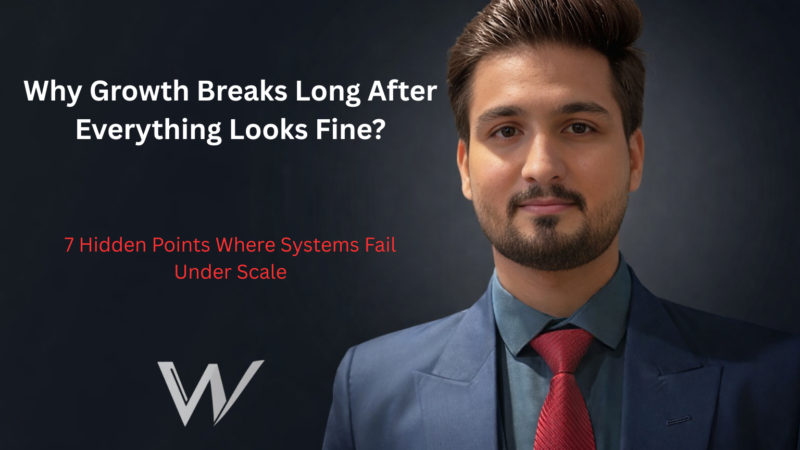
The 7 Hidden Points Where Systems Fail Under Scale
Why Growth Breaks Long After Everything Looks Fine. Most systems break later when growth has already been normalized and that’s what makes failure under scale so deceptive.
From the outside, everything appears fine:
- Revenue is up
- Headcount has increased
- New tools are in place
- Meetings are full
- Activity is constant
- The organization looks grown
And yet, something feels off.
- Decisions take longer
- Simple changes require coordination
- Ownership feels fuzzy
- Recovery from small issues takes more effort than it used to
Nothing is on fire but nothing feels solid either. This is the stage where most leaders misdiagnose the problem.
They look for tactical fixes:
- another process
- another hire
- another dashboard
- another planning session
What they’re actually dealing with is something structural. Scale reveals the problems that were already there. In calm conditions, systems are forgiving, people compensate, judgment fills gaps, experience smooths rough edges and intelligence acts like glue.
Under scale, that glue dries out. Volume increases the cost of every unclear decision. Distance weakens informal coordination. Time pressure exposes brittle assumptions.
What used to work well enough stops working quietly. That’s why systems fail under scale without announcing it. They erode before they collapse and erosion is easy to ignore especially when things still appear successful.
This article is not about catastrophic failure, it’s about the seven subtle pressure points where systems quietly lose integrity as they grow.
You won’t see these points on org charts, you won’t find them in tool stacks and you won’t fix them with hustle. You notice them only if you’re paying attention to how decisions actually move through the system.
Table of Contents
1: Ownership Becomes Abstract
Early-stage systems have one unfair advantage: proximity.
When teams are small, ownership is obvious because everyone can see everything.
You know who’s responsible because:
- you sit next to them
- you talk daily
- you feel the impact immediately
Ownership doesn’t need structure when proximity does the job. Scale removes proximity and when proximity disappears, ownership must become explicit or it dissolves.
This is where the first major failure occurs. Instead of clear ownership, systems develop conceptual ownership:
- That’s handled by the team
- It lives with operations
- Product owns that
Those statements sound reasonable, they are also dangerously vague. Teams don’t own outcomes, people do.
When ownership becomes abstract, responsibility diffuses. Decisions slow down. Accountability turns into interpretation and everyone is partially responsible which means no one is fully responsible.
This does not cause immediate damage, it causes hesitation and hesitation compounds.
- People stop making calls unless they’re certain
- They escalate decisions that used to be made locally
- They wait for alignment instead of acting
The system still functions but with friction and because friction increases gradually, leadership often mistakes it for growing pains instead of structural failure.
Here’s the subtle shift that matters:
In fragile systems, ownership is defined by roles.
In durable systems, ownership is defined by decisions.
Roles change, decisions persist.
If you can’t clearly answer:
- Who decides this?
- Who feels the consequence?
- Who fixes it when it goes wrong?
Then ownership is not defined, it’s assumed and assumed ownership is one of the earliest ways systems fail under scale.
2: Exceptions Outnumber Rules
Every system starts with rules, then reality arrives.
- A special client
- A tight deadline
- An edge case that won’t happen often
So an exception is made. The exception works, nothing breaks, everyone moves on and that’s how fragility begins.
Exceptions feel harmless because they’re framed as temporary. But systems rarely track exceptions properly. They accumulate them quietly, one at a time, until the exception becomes the real system and the rules become decorative.
At small scale, people remember the exceptions.
At scale, no one does.
New hires learn by copying behaviour, not reading documentation. They see what actually happens not what the system claims to support. Over time, rules lose authority and exceptions become normalized.
The system still appears flexible, what it’s actually doing is eroding predictability and predictability is what allows systems to scale without constant supervision.
When exceptions outnumber rules, every decision becomes situational. Situational decisions require judgment. Judgment requires context and context doesn’t scale.
That’s why systems fail under scale not because they lack flexibility, but because they lack boundaries. Durable systems don’t eliminate exceptions, they contain them. Fragile systems let exceptions teach the system how to behave and systems fail under scale.
3: Decisions Drift Away from Consequences
Early on, decisions are made close to their outcomes. If something goes wrong, the same person feels it. If something works, the feedback is immediate.
Scale breaks that loop. As organizations grow, decisions move upward or outward. Outcomes move downward or sideways. The people making calls stop feeling the direct cost of those calls.
This separation is subtle and incredibly dangerous. When decision makers are insulated from consequences, risk tolerance changes.
- Small trade-offs seem cheap
- Delays feel abstract
- Complexity feels manageable on paper
The system begins to approve decisions that look reasonable locally but create stress globally. No one is reckless, no one is malicious, the system simply stops learning from pain.
When decisions drift away from consequences, feedback weakens. When feedback weakens, correction slows and when correction slows, fragility compounds quietly and systems fail under scale.
Durable systems preserve feedback loops. Fragile systems dilute them.
4: Coordination Replaces Judgment
At scale, coordination feels like maturity.
- More meetings
- More alignment
- More stakeholders
This is often celebrated as progress but there’s a point where coordination starts replacing judgment instead of supporting it.
- People stop making decisions because they’re waiting for input
- They wait for input because responsibility feels shared
- Responsibility feels shared because ownership is unclear
So the system coordinates instead of deciding. Coordination is expensive. Judgment is decisive.
Smart teams over-coordinate because they don’t want to be wrong alone and fragile systems reward that behaviour by punishing unilateral action more than collective delay.
Over time, speed decreases, accountability blurs, people become excellent at managing dependencies and terrible at moving forward. Nothing breaks outright, everything just takes longer than it should.
This is one of the most common ways systems fail under scale not through chaos, but through polite stagnation.
5: Metrics Lag Reality
Metrics are supposed to reflect reality. At scale, they often trail it.
As systems grow, measurement becomes abstract.
- Dashboards summarize what already happened
- Reports smooth out anomalies
- Trends replace signals
By the time a metric changes, the underlying issue has already spread. This creates a false sense of control.
Leadership believes they’re managing the system because numbers are visible. The system believes it’s being monitored because it’s being measured. But measurement without immediacy is not control, it’s documentation.
Fragile systems rely on lagging indicators. Durable systems design for early signals. When metrics lag reality, teams optimize for what’s visible, not what’s true. Problems become official only when they’re already expensive.
That’s why suddenly systems fail under scale, the failure was visible long before the metrics caught up.
6: Recovery Depends on Specific People
This one feels flattering until it is not. Every fragile system has heroes.
- People who know how things really work
- People who fix problems quietly
- People everyone relies on when something goes wrong
These people are competent often exceptional, they’re also load bearing. When recovery depends on specific individuals, the system is not resilient, it’s borrowed time.
As scale increases, the frequency of issues increases too, the heroes get busier and their knowledge becomes more valuable and more concentrated.
Eventually:
- they burn out
- they leave
- or they become bottlenecks
And when they’re unavailable, the system does not degrade gracefully but stalls. Durable systems don’t eliminate expertise, they distribute it. Fragile systems confuse heroism with strength.
7: The System Stops Learning
This is the point of no return, systems don’t collapse when they start failing but they collapse when they stop correcting.
Early on, systems learn naturally. Mistakes are visible, feedback is immediate, people talk openly about what went wrong because the cost of being wrong is low and the distance between action and outcome is short.
Scale stretches that distance.
- Mistakes become harder to trace
- Feedback becomes indirect
- People become careful with language
Not because they’re dishonest but because the system made honesty expensive. This is where learning quietly slows down.
- Post mortems turn vague
- Retrospectives become polite
- Problems are reframed as edge cases or timing issues
The system keeps moving but it stops updating its internal model of reality. When a system can’t learn, it can’t adapt. When it can’t adapt, every small failure becomes cumulative.
This is the most dangerous form of fragility because it looks like stability.
- Everything is documented
- Everything is reviewed
- Everything is discussed
And yet nothing fundamentally changes. At this stage, teams don’t even realize the system is failing. They believe they’re managing complexity, when in reality they’re normalizing dysfunction.
Learning systems evolve. Fragile systems repeat. Once repetition replaces reflection, failure is only a matter of time.
Why These Failures Are So Hard to Catch Early
None of the seven failure points announce themselves. There’s no alert that says:
Ownership is now abstract
Exceptions are accumulating
Decisions no longer feel consequences
The system keeps working just with more effort, more coordination, more explanation. That’s why leaders often sense something is wrong long before they can articulate it.
They feel:
- increased drag
- slower execution
- rising stress
- diminishing returns on effort
But they don’t see a single obvious cause. That’s because these failures are structural, not operational.
You don’t fix them by pushing harder. You fix them by redesigning how decisions flow, how feedback travels, and how learning is enforced.
A Pattern Worth Naming
Look back at all seven failure points together and one pattern becomes clear:
Systems fail because growth changes how decisions behave, and the system was never redesigned to handle that change.
Scale:
- increases distance
- multiplies exceptions
- slows feedback
- hides consequences
- rewards coordination over judgment
If the system stays the same while the environment changes, fragility is inevitable. This is why things were working fine before is one of the most dangerous sentences in growing organizations.
They were working under different conditions.
The Quiet Difference Between Fragile and Durable Systems
Fragile systems depend on:
- memory
- goodwill
- heroics
- interpretation
Durable systems depend on:
- design
- constraints
- feedback
- learning
One scales by effort and the other scales by structure.
The reason durable systems feel boring is because they remove drama. They eliminate the need for constant intelligence, urgency, and recovery and that’s exactly why they survive.
If you’re seeing pieces of your own system in this article, don’t rush to diagnose everything at once.
The goal is not to fix all seven points immediately. It’s to notice which one shows up first when pressure increases. That’s usually where the real work begins.
Why Systems Rarely Collapse All at Once
Systems don’t snap, they thin.
- They lose redundancy
- They lose feedback
- They lose trust in their own structure
By the time something visibly breaks, the system has already been failing quietly for a long time. That’s why reactive fixes feel so unsatisfying, they arrive late.
Durability is designed earlier, when things still look fine.
Why Systems Don’t Collapse, They Erode
Most leaders expect failure to look dramatic, it doesn’t.
It looks like:
- more meetings
- more process
- more coordination
- more explanation
It looks like everyone working harder for slightly worse outcomes.
That’s erosion and erosion does not respond to urgency, it responds to design.
If this article felt uncomfortably accurate, good. That usually means you’re seeing patterns that were previously invisible.
I work with founders and operators who are done patching symptoms and ready to design systems that don’t quietly decay as they grow.
If you have any questions or you want to get in touch, feel free to connect with me on LinkedIn.
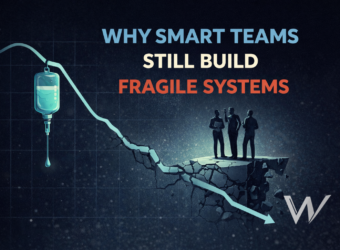
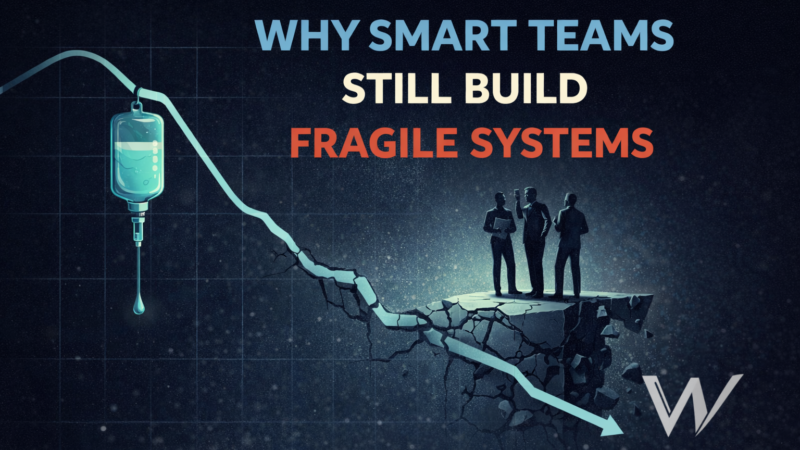
Why Smart Teams Still Build Fragile Systems
Most systems fail because the people involved are too smart for their own good. That sounds backwards bit it’s not.
Smart teams are excellent at solving problems in the moment.
- They are fast, adaptive, creative.
- They patch, workaround, improvise, and recover.
- They keep things moving.
- They make chaos look manageable.
And that’s exactly why they end up building fragile systems.
Fragile systems don’t look broken but they look functional until they are not. They work because intelligent people are constantly compensating for them:
- Quietly
- Repeatedly
- Without writing it down
That compensation becomes invisible, the fragility gets baked in and the system starts depending on heroics instead of design. This is how smart teams accidentally create environments that collapse the moment pressure increases.
Table of Contents
Why Intelligence Feels Like a Substitute for Structure
Intelligence is seductive. When you have capable people, things tend to work even when the system underneath is a mess.
- Deadlines are met
- Clients are handled
- Fires are put out
- Everyone feels busy, important, needed
That creates a dangerous illusion:
We don’t need to fix this properly. We can handle it.
And for a while, they can. This is the origin story of most fragile systems.
Smart people are very good at hiding structural flaws especially from leadership.
- They know where the landmines are
- They know which steps to skip
- They know who to call when something breaks
None of that knowledge lives in the system, it lives in people’s heads. Which means the system itself learns nothing.
Fragile Systems Are Quietly Propped Up by Humans
Here’s the pattern you see again and again:
- A process technically exists, but no one follows it exactly
- Exceptions are handled informally
- Decisions rely on who’s around rather than rules
- Documentation exists, but reality diverges from it
- Everyone knows which parts to ignore
From the outside, everything looks fine. From the inside, everyone knows it’s being held together by context and experience.
That’s debt and the smarter the team, the more debt they can carry for a while. This is why fragile systems often survive longer in high-performing environments. Intelligence delays failure, it does not prevent it.
The Moment Smart Teams Break
Fragile systems don’t fail randomly. They fail at predictable moments:
- When new people join
- When volume increases
- When timelines compress
- When key people leave
- When stakes rise
In calm conditions, intelligence compensates.
Under pressure, compensation runs out.
Suddenly:
- Decisions slow down
- Mistakes multiply
- Ownership gets fuzzy
- Stress rises
- Blame starts circulating
Everyone feels like they’re working harder, yet outcomes worsen. That’s the signature of a fragile system finally being exposed.
Why More Talent Makes It Worse
Here’s where teams make their second mistake. When things start cracking, they hire smarter people.
- More senior people
- More experienced people
- More capable people
This helps temporarily and makes the underlying issue worse. Why? Because high performers are even better at working around broken structures.
- They normalize chaos
- They solve locally
- They don’t complain much
Leadership interprets this as progress. What’s actually happening is that fragility is being reinforced at a higher level. The system becomes dependent on exceptional individuals instead of reliable design.
That is not scale, that is fragility with better PR.
Fragile Systems Reward the Wrong Behavior
This is subtle but critical. Fragile systems reward:
- Fast reaction
- Personal heroics
- Being the go-to person
- Fixing things quietly
They punish:
- Slowing down
- Asking for structure
- Making work visible
- Designing for absence
Over time, people learn what’s valued. They stop improving the system and start optimizing their own importance within it because the environment trained them that way.
This is how fragile systems become culturally protected.
The Difference Between Smart Execution and Durable Execution
Smart execution gets things done now. Durable execution keeps working later.
Smart teams often optimize for the present because the present is loud. Durable systems are quiet. They don’t demand attention until they’re missing.
That’s why most organizations overinvest in intelligence and underinvest in structure. Structure feels slow. Intelligence feels impressive. Until the system is asked to operate without its best people present.
That’s the real test.
A Simple Test for Fragility
Here’s a diagnostic that cuts through everything. Ask this question honestly:
If our strongest people disappeared for two weeks, what would stop working?
Whatever your answer is, that’s where fragility lives. In the parts of the system that rely on memory, judgment, or presence instead of design.
Fragile systems work because someone remembers.
Durable systems work because the system remembers.
Why Documentation Alone Does not Fix Fragile Systems
This is where many teams overcorrect. They notice fragility and respond with documentation.
- More docs
- More SOPs
- More process diagrams
But documentation that describes an unstable reality just freezes the problem in writing. If the system itself does not enforce behaviour, documents become optional.
People follow them until it’s inconvenient. Then they rely on experience again. Durability isn’t created by describing work but it’s created by constraining it.
Good systems don’t ask people to remember the right thing, they make the wrong thing hard to do.
Fragile Systems Love Flexibility (Too Much)
Flexibility sounds good and it is in moderation. But fragile systems use flexibility as an excuse to avoid decisions.
Instead of defining:
- Who owns what
- When exceptions are allowed
- What trade-offs matter
They leave things open. That openness feels empowering and it’s actually avoidance.
Every undefined rule becomes a future decision someone has to make under pressure. Smart people handle it until there are too many of those decisions.
The Hidden Cost of Being Good in a Crisis
Some teams take pride in how well they handle chaos.
- They joke about it
- They bond over it
- They wear it like a badge
This is dangerous. Being good in a crisis usually means the system produces crises regularly and that’s familiarity with failure.
Resilient systems reduce the need for heroics.
Fragile systems celebrate them.
If you’re reading this and recognizing patterns you’ve normalized, don’t rush to fix anything yet.
Just notice where intelligence is compensating for structure in your environment. That awareness alone changes how you see the system.
No action needed yet. Just attention, the right kind.
Why Fragile Systems Feel Efficient
Fragile systems often feel faster.
- They cut corners
- They bypass steps
- They rely on intuition instead of process
In the short term, this looks like efficiency. In reality, it’s deferred cost.
The bill arrives later during growth, transition, or stress when speed matters most and fragility becomes expensive. Efficiency without durability is just delayed friction.
The Myth of We’ll Fix It Later
Later is where fragile systems go to die because later never arrives as planned. When teams say we’ll clean this up later, what they mean is:
We’re choosing short-term comfort over long-term stability
Sometimes that’s a valid trade. Most of the time, it’s an unexamined habit.
Smart teams get away with this longer than most which is why they’re often the most surprised when things finally break.
Why Fragile Systems Are So Hard to See from the Top
Leadership often does not see fragility because outcomes still look acceptable.
- Revenue is fine
- Clients are happy
- Projects are shipping
The cost is paid internally:
- Stress
- Rework
- Silent burnout
- Invisible effort
By the time fragility shows up in metrics, it’s already entrenched. This is why durable systems must be designed intentionally not reactively.
What Durable Systems Actually Optimize For
Durable systems don’t optimize for speed or flexibility first. They optimize for:
- Predictability
- Absence tolerance
- Clear ownership
- Fewer decisions under pressure
They assume people will be tired, distracted, or unavailable and design accordingly and it’s respect for reality.
The Shift Smart Teams Have to Make
The hardest transition for smart teams is this:
Moving from problem solving to problem prevention
Prevention is boring. It does not create stories and it definitely does not make anyone look heroic but it’s the difference between fragile systems and durable ones.
You need fewer moments where intelligence is required to keep things from falling apart.
A Question Worth Sitting With
Here’s one to end on, not to answer immediately, just to sit with:
Where would our system fail if people stopped compensating for it?
That question has nothing to do with talent but everything to do with design.
If this article felt uncomfortably familiar, that’s usually a good sign. It means you’re seeing the difference between intelligence and structure clearly for the first time.
I work with founders and operators who are done relying on smart people to hold broken systems together and ready to design systems that don’t collapse when intelligence steps away.
If you have any questions or you want to get in touch, feel free to connect with me on LinkedIn.
Outcomes & Experience
Ethan Walker Founder - B2B SaaS
Working with Wajeeh was about fixing how everything fit together. From structure to messaging, systems became clear, execution got faster, and results followed naturally.
Growth stopped feeling chaotic.
Daniel Brooks Head of Growth
Wajeeh helped me rethink what a website is supposed to do. Not design for looks but a trust and decision system.
Everything felt intentional, clear, and aligned with the brand instead of working against it.
Omer Founder - SaaS & Cloud Infrastructure
Wajeeh designs the foundation first rather than jumping to execution. Every decision, system, and flow worked together with intent. The result was clear structure, faster execution, and growth that actually made sense.
Haseeb Senior Backend Engineer - Growth Systems
Working with Wajeeh felt like building with someone who already saw where things were going. He turns vision into systems that last, leads with intention, and builds with long term weight in mind.
The kind of leadership that changes how you think.
Sarah Mitchell Head of Marketing - SaaS
He didn't treated websites and content as isolated projects. He builds decision systems that earn trust and guide action naturally.
What we ended up with was cleaner and durable.
Noman Growth & Digital Strategy
Wajeeh structured our brand and growth ecosystem for real US and Canadian markets.
Clear positioning, consistent messaging, and systems that reinforced each other instead of competing for attention
Lauren Hayes Brand & Strategy Lead
Instead of adding more tactics, Wajeeh removed confusion.
The structure we gained changed how decisions were made company wide.
Jason Miller Technical Consultant - Enterprise Systems
Wajeeh helped us reduce internal friction before chasing growth.
Once structure was in place, execution became easier across the board.
Let’s Talk Systems
I work with founders and operators building things meant to last.
If you’re thinking beyond short term tactics and want systems that compound, this is the right place to reach out.
I don’t take on everything, context matters.